




Transparently and objectively. See how CEUTP evaluates applications for funding
In the course of years of experience, the Center for EU Transport Projects has developed a methodology to achieve full transparency and equal treatment of all applicants in competitions.
Funding for investments is granted by CEUTP through calls for proposals. Each call relates to a specific area of intervention consistent with a given European Funds program.
We divide recruitment into competitive and non-competitive
Non-competitive ones are targeted in advance to a specific applicant, with no open competition or comparison of projects – instead, we check the compliance of projects with the program’s objectives. Most often, such calls are for selected strategic projects, such as those related to rail infrastructure.
Other calls – competitive ones – are directed to a wide range of entities, and support is given to the best projects. For example: within the framework of the European Funds for Infrastructure, Climate, Environment 2021-2027 program, we have already announced competitive calls directed, among others, to companies related to intermodal transport or to railroad companies, which, thanks to external funds, will be able to invest in the purchase of modern rolling stock.
But how do we select the projects to which support will go?
Criteria in competitive admissions
Below we describe in detail the evaluation process in competitive calls.
The basis for evaluation is a point system. Each of the incoming applications to CEUTP is evaluated in terms of meeting certain mandatory criteria.
In the second stage – from among the projects that meet all formal requirements – points are awarded to create a final ranking list.
The monitoring committees of individual European Funds programs, operating under the Ministry of Funds and Regional Policy, are responsible for adopting the list of project selection criteria. The Center for EU Transport Projects announces calls for proposals based on the regulations approved by the MFiPR and the criteria adopted by the relevant monitoring committee.
The criteria fall into two categories:
- Horizontal – are fixed for all calls within a given European Funds program. This means that regardless of which economic field is affected by a call in the FEnIKS program, the horizontal criteria always remain the same;
- Specific – thematic, assigned to a specific FEnIKS measure, and therefore related to the subject matter of a particular call.
Both horizontal and specific criteria are further divided into mandatory and ranking criteria.
What it means. Mandatory criteria are those that a potential Beneficiary must meet in full in order to receive support. They usually take the form of questions to which evaluators must answer “yes” or “no.” A negative answer already at this stage eliminates the project from further evaluation.
In the case of ranking criteria, we award the appropriate number of points for meeting the requirements. Importantly: failure to receive points for some criteria does not exclude the application from further processing.
Throughout the call, applicants have access to the full list of criteria, which we publish in the competition documentation. In the case of calls from the FEnIKS program, these are Annexes 4a and 4b to the Competition Regulations.
In addition: after the announcement of a competitive call, CUPT, as a rule, organizes training on call documentation and criteria for potential applicants.
At the stage of recruitment, questions may be asked via a dedicated e-mail address. To ensure equal access to information – we publish all answers on our website.
Documentation is key
The documents made available with the announcement of the launch of the competition contain the most important information on the rights and obligations of Applicants.
For example: the User’s Guide for the WOD application (Appendix 2) specifies the documents required to be provided in a given call. These may include feasibility studies, analyses or statements. Lack of these documents prevents full evaluation of the project by CEUTP experts.
If there are deficiencies or inaccuracies in the application, each Applicant is given an equal opportunity to complete or correct them. The Regulations provide for the opportunity to submit comments in certain circuits: sometimes there is one, sometimes two or three, depending on the call.
We give each Applicant the same amount of time to submit explanations, if any, while maintaining the principles of equality and fairness to all potentially interested parties. We also endeavor to respond on an ongoing basis to any questions regarding comments submitted by CEUTP.
Evaluation and analysis process
After the submission stage of the call for proposals, a list of all submitted applications is drawn up. In the next stage, the KOP is appointed : Project Evaluation Committee.
Each project is assigned to a team of specialists: representatives of project departments, persons in charge of the Cost-Benefit Analysis, environmental impact assessment experts and a person dealing with public assistance issues.
The decision on which employees will evaluate a particular project is made by the management of the departments involved in conducting the call. Prior to the start of the evaluation, all appointed members of the committee shall submit declarations of confidentiality and declarations of impartiality regarding all projects submitted in the competition – under pain of criminal liability.
Importantly: in the case of the possibility of a potential conflict of interest, the person in question does not participate in the evaluation of the project. Throughout the evaluation process, only members of the 7-person group directly assigned to a specific project have access to the detailed data contained in the application. Other members of the committee can only see basic information: the name of the project, the name of the Beneficiary and the application number – the rest of the documents remain secret to them.
The list of all members of the Project Evaluation Committee is made public along with the ranking list.
All data submitted by applicants are reviewed in detail by CEUTP’s team of experts. We study long-term prospects of financial flows, check demand forecasts or economic indicators of projects. In the analysis, we rely on estimates prepared by the Applicants. We check whether these estimates are underestimated or overestimated – using our experience and publicly available data from, for example, the Central Statistical Office.
To maintain the highest standards of transparency, as a rule, each stage of the analysis is carried out by at least two people. Such a solution significantly reduces the risk of errors and strengthens the credibility of the entire evaluation process.
High ranking and reduced funding – why does this happen?
It may happen that a project is ranked high and yet receives lower funding. Such a scenario is possible in the case of calls for proposals for intermodal transport. Support for this sector is covered by the rules on state aid – the rules for granting support were subject to approval by the European Commission. According to them, support for publicly co-financed projects must not lead to above-average profits for the investor.
In practice, this means that the average annual return on investment may not exceed 20%. In doing so, it is necessary to take into account industry and macroeconomic risks, including geopolitical changes or crisis situations, such as the COVID-19 pandemic.
If any project exceeds this level – it still has a chance to receive funding, but at a reduced level, ensuring that the allowed return on investment is not exceeded. Such a solution ensures that aid is limited to the necessary minimum – which is one of the conditions for the admissibility of state aid and promotes a level playing field.
Thanks to clearly defined criteria, multi-stage evaluation and strict rules of impartiality, the Center for EU Transport Projects has invariably provided a transparent and objective process for selecting projects for funding for almost 20 years. Each Applicant has access to the same information and is subject to identical evaluation rules. It is these standards that allow funds to be directed where they are needed most – to projects that bring the greatest value to transportation, the economy and society as a whole.
EFICE
 28 June 2026 | EFICE
More Road Projects Funded by European Funds
Two more projects by the General Directorate for National Roads and Motorways have received funding from the European Funds for Infrastructure, Climate, and Environment Program 2021–2027. These projects involve the construction of the Morawica and Wola Morawicka bypass along National Road DK73, as well as sections of the S19 expressway between Międzyrzec Podlaski and Lubartów Północ.
More
 25 June 2026 | EFICE
CEUTP Training for Employees of Provincial Monument Preservation Offices
On June 16–17, 2026, CEUTP experts conducted a training session in Wrocław for employees of the Provincial Offices for the Protection of Historical Monuments, focusing on the principles for implementing a technical assistance project under the European Funds for Infrastructure, Climate, and Environment 2021–2027.
More
 25 June 2026 | EFICE
Expert Workshop on Dual-Use Projects and Transportation Resilience, Featuring CEUTP
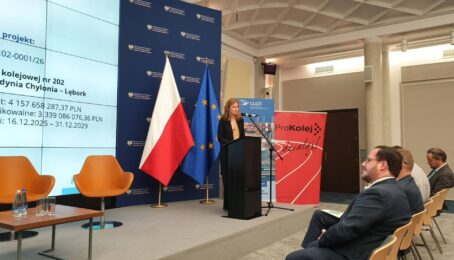
On June 19, 2026, an expert workshop titled “Dual-Use Projects and Building the Resilience of the Railway System with the Support of European Funds” was held in Warsaw. Among those participating in the event was Sylwia Cieślak-Wilk, deputy director of CEUTP, who presented an institutional perspective on the role of dual-use infrastructure in the EU’s current and future financial frameworks.
More
 25 June 2026 | EFICE
Nearly 424.6 mln zł from European Funds for the modernization of the Ujście Nysy barrage
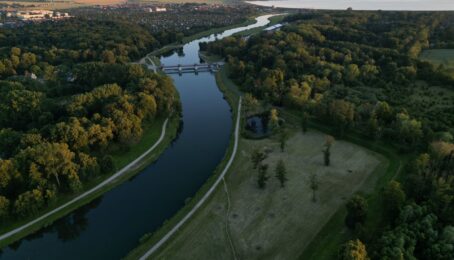
The Center for EU Transport Projects has signed two agreements with the State Water Management Authority “Wody Polskie” regarding the modernization of the Ujście Nysy weir on the Oder River. The projects, with a total value of over 538 mln zł, will receive nearly 424.6 mln zł in funding from the European Funds for Infrastructure, Climate, and Environment 2021–2027 program.
More
Contact us
Plac Europejski 2, 00-844 Warsaw
Monday – Friday,
hours: 8:15 am – 4:15 pm


