




Mobility is independence. How accessible transportation supports active aging
Population aging is one of the key development challenges of the coming decades. Projections indicate that by 2050, people aged 60+ will make up more than 40% of Poland’s population. This means a growing need to design transportation solutions that not only enable movement, but realistically support the independence, activity and quality of life of the elderly.
Research in Poland and Europe clearly shows that seniors’ mobility has a direct impact on their physical and mental health, level of social activity and sense of independence. At the same time, many seniors continue to experience barriers – infrastructural, informational and digital – that limit the use of public transportation and promote mobility exclusion.
“The social activity of people with limited mobility depends on their ability to move independently, and providing accessibility gives them a real chance to do so.” (Source: Modern infrastructure in the service of accessibility, CUPT, 2019)
The problem: transportation accessibility vs. exclusion of seniors
Contrary to popular belief, transportation accessibility is not just for people with disabilities. These solutions are also crucial for seniors, who – due to their age – more often face deteriorating mobility, vision or hearing.
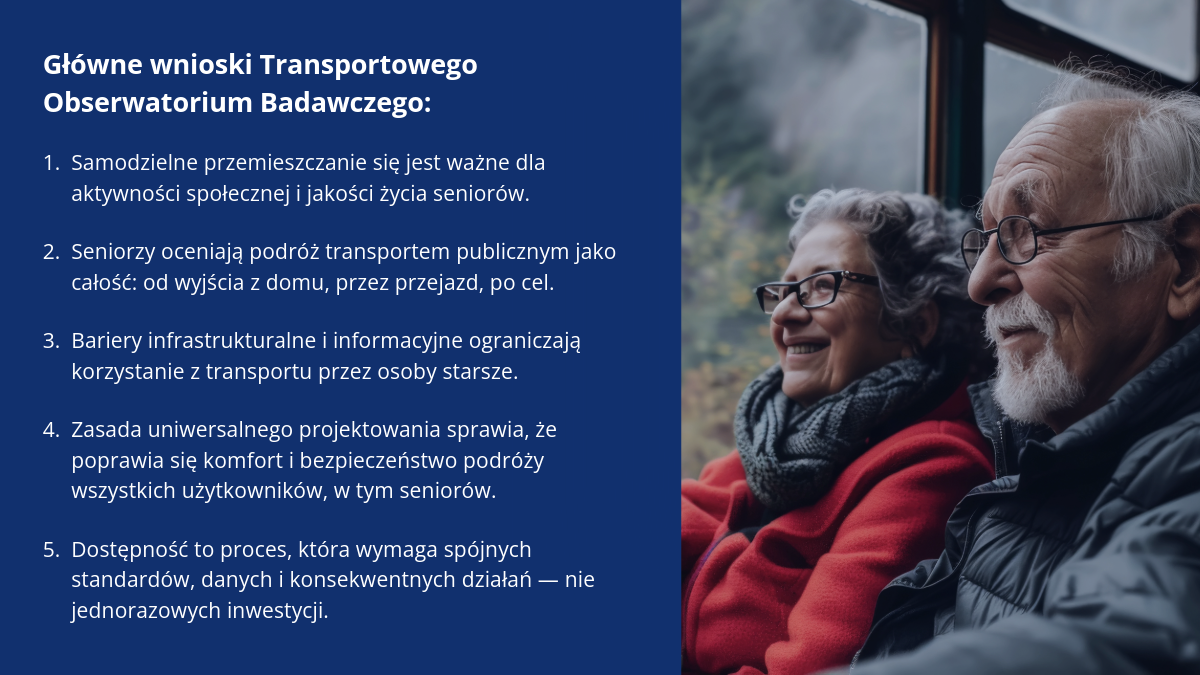
As analysis by the Transportation Research Observatory shows, barriers such as high steps in vehicles, lack of elevators, illegible passenger information or digital-only service systems effectively limit the independence of the elderly and lead them to abandon public transportation in favor of the car or stay at home.
“The accessibility of transportation infrastructure is not an end in itself. New or upgraded infrastructure only makes sense if it actually enables users’ daily transportation needs to be met.” (Modern Infrastructure in the Service of Accessibility, CUPT, 2019)
The main reasons are:
- lack of sufficient low-floor rolling stock or difficult access to vehicles,
- still unsuitable bus stops and stations (no elevators, long walkways),
- illegible passenger information,
- service systems based exclusively on digital solutions.
Hence, effective solutions require thinking about travel as a sequence of events – from leaving home, getting to the bus stop, boarding, traveling, and arriving safely at the destination. This approach has become the foundation of recommendations for projects co-financed by the European Funds.
Activities: Accessibility 2030+ and Universal Design
In response to the identified needs, CUPT is supporting activities implemented under Accessibility 2030+, focusing on:
- Purchase and upgrade low-floor rolling stock,
- Elimination of architectural barriers at stations and stops,
- Implementing consistent, clear passenger information systems,
- Training of passenger service personnel,
- Promoting universal design principles.
“Accessibility is a continuous process that requires the cooperation of administration, beneficiaries, experts and users. Its result is greater mobility and, consequently, greater independence and a better quality of life.” (Modern Infrastructure in the Service of Accessibility, CUPT, 2019)
Effects: investments from European Funds
Ongoing transportation projects co-financed by European Funds – including railroads, urban transportation and multimodal infrastructure – show that accessibility has measurable social effects:
- Increasing the number of independent trips by the elderly,
- Improving the comfort and safety of users,
- Reducing traffic exclusion,
- Support for active aging where you live.
These are investments that serve today’s seniors, but also address the needs of future generations.
Press releases
 21 May 2026 | Various
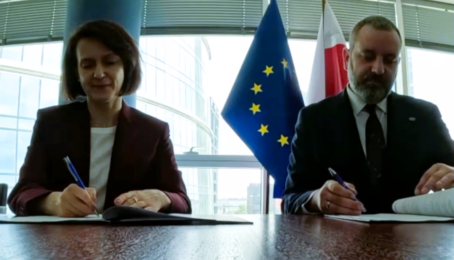
CEUTP and Pomeranian University join forces to develop transportation and competencies for the future
We have entered into a cooperation agreement with the Pomeranian University of Science and Technology (PSW) to work together in the areas of research, education and development of the transportation sector, with a particular focus on projects co-financed by the European Union.
More
 19 May 2026 | CEF2
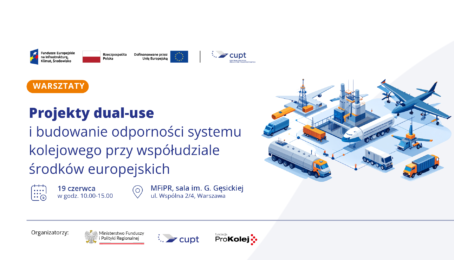
CEUTP at workshop on dual-use projects and rail resilience
On June 19, 2026, the Ministry of Funds and Regional Policy in Warsaw will host an expert workshop entitled. “Dual-use projects and building the resilience of the railroad system with the participation of European funds”. The event is organized also jointly with CEUPT and the ProKolej Foundation.
More
 28 April 2026 | EFICE
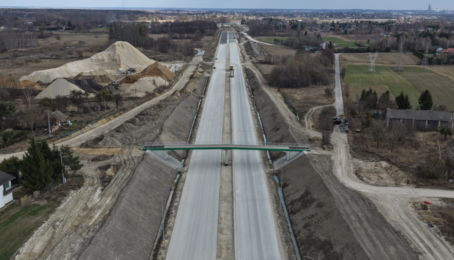
Construction of Chelm bypass with support from European Funds
Convenient connection to Ukraine and moving transit traffic out of Chelm – these are among the most important benefits of the construction of the S12 expressway section. The investment has just been awarded nearly PLN 225 million from the European Funds for Infrastructure, Climate, Environment 2021-2027 (EFICE).
More
 27 April 2026 | Various
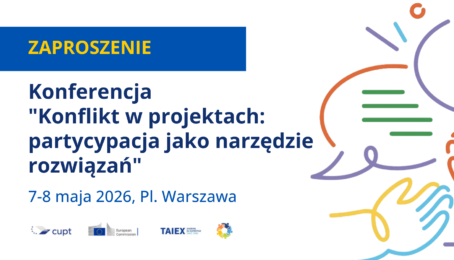
Last moment to register! Conference on public participation in transportation planning
This is the last chance to sign up for the conference “Conflict in design: participation as a tool for solutions”, dedicated to the role of public participation in planning and investment processes in the area of transport. The event will take place on May 7 – 8 this year in Warsaw.
More
Contact us
Plac Europejski 2, 00-844 Warsaw
Monday – Friday,
hours: 8:15 am – 4:15 pm


