




New DNSH Guidelines for the Next Financial Perspective – When Will We Know the Details?
On 18–19 May, a two-day workshop dedicated to the practical application of the Do No Significant Harm (DNSH) principle in EU-funded projects took place in Brussels. Each Member State delegated two experts. Poland was represented, among others, by Ewa Paderewska, Head of the Environmental Protection Unit at CEUPT.
During the meeting, representatives of the European Commission presented the assumptions for the development of new, unified DNSH guidelines for the next programming period (MFF). The discussion demonstrated strong support for maintaining DNSH as an important environmental protection tool, while also highlighting the need to simplify and clarify
its application.
Participants positively assessed the fact that, prior to drafting the guidelines, the Commission
is conducting broad consultations with experts from various sectors and Member States. This approach allows for the collection of practical experience in implementing DNSH and a better understanding of the challenges faced by institutions and beneficiaries when assessing project compliance.
The debate focused both on solutions that have worked well in the current financial perspective and on areas requiring improvement. Although the new DNSH guidelines have not yet been published, one point was particularly clear: DNSH must not become merely a reporting obligation or an excessive administrative burden. It should remain a practical tool supporting the sustainable development of projects.
The Commission emphasized that future DNSH frameworks should continue to effectively protect the environment while being simpler, more practical, and result-oriented.
Key proposals for the future DNSH framework
- Proportionality – DNSH requirements should be adjusted to the scale and potential impact of the project. For small investments with no significant environmental impact, compliance with national regulations could be sufficient.
- Simplicity and clarity – the rules should be understandable for both public administration and beneficiaries. It was noted that requirements are often overly complicated by external consultants who may lack sufficient sector-specific expertise. Future guidelines should therefore be clearer and easier to apply.
- Practical approach – a lot of space was devoted to the issue of documents and evidence required to confirm compliance with DNSH. It was pointed out that:
-
- DNSH should not duplicate obligations arising from EU or national law,
- Requirements should be proportionate to the type and scale of the project,
- Results-oriented approach – DNSH should support efficient project implementation rather than hinder it.
- Exclusion list – many participants called for a catalogue of activities automatically excluded from DNSH assessment.
Climate adaptation and infrastructure resilience
In the area of climate adaptation, strong emphasis was placed on increasing the use of nature-based solutions (NBS) instead of traditional grey infrastructure. Participants also highlighted the importance of strengthening the “resilience by design” principle, meaning that climate resilience should be incorporated at the design stage and in procurement documentation.
Stronger link between EIA and DNSH
One of the key topics was the relationship between Environmental Impact Assessment (EIA) and DNSH. Participants agreed that the current approach often leads to duplication of EU legal requirements and called for better alignment.
For projects covered by Annexes I and II of the EIA Directive:
- The environmental assessment should remain the responsibility of the competent environmental authority,
- Obtaining an environmental decision should, in principle, confirm compliance with DNSH.
For smaller projects not requiring an environmental decision, national environmental standards and technical regulations were considered sufficient.
Additionally, the need to reflect requirements stemming from:
- Critical Raw Materials Act,
- Nature Restoration Law,
- and issues such as light pollution, was highlighted.
Possible exclusions from DNSH assessment
The discussion also covered activities that could potentially be exempted.
Among the examples appeared:
- Reconstruction and modernization of existing infrastructure,
- Non-electrified railway lines in regions with limited energy infrastructure or difficult terrain,
- Specialized vehicles which, due to their function, may require exemptions from zero-emission rules
- Research projects in line with program strategies and objectives.
At the same time, activities that in principle should not be considered DNSH-compliant such as landfills, MBT facilities, waste incinerators, deep-sea mining and marine geological engineering have been identified.
Circular economy challenges
In the area of the circular economy (CE), several practical challenges were raised, including:
- How to confirm that the waste is indeed not recyclable
- How to assess the lack of available alternative technologies
- How to demonstrate that a given selected technology is Best Available Technology (BAT).
It was also stressed that the DNSH guidelines should not point to specific technologies, as scientific and technical development is very dynamic.
Monitoring and verification
Much attention was also paid to monitoring compliance with DNSH. Especially in the case of large investments covered by the EIA, questions arose:
- what level of detail of evidence will be required
- Which duties are already being carried out under existing administrative procedures.
It was pointed out that many environmental conditions are already controlled by:
- decision-making bodies
- construction supervision
- Environmental supervision at the construction site.
Flexibility and national specificity
Participants stressed that the future DNSH framework should take into account differences among member states due to different environmental conditions, risks and national challenges.
Among the proposals were:
- national focal points for the development of the country. DNSH
- contact points at managing and intermediate bodies
- A permanent working network for sharing experiences and information.
It was also proposed that member states could develop their own criteria for implementing DNSH, tailored to national circumstances and supported by scientific and technical arguments.
Next steps
The Commission said that the unified DNSH guidelines being prepared will be based on the experience of previous years, and will aim to simplify requirements, reduce fragmentation between funds, and create a more practical and useful tool for institutions and beneficiaries. A draft of the new DNSH guidelines is expected to be published by the European Commission in July or August. We encourage everyone to stay informed and actively participate in the consultation.
International cooperation
 22 May 2026 | International cooperation
DG REGIO Peer2Peer Public Procurement: third meeting in 2026 with in the framework of international cooperation
On 14 May, the third online meeting in 2026 of the DG REGIO Peer2Peer Public Procurement group took place, with the participation of an expert from Center for EU Transport Projects (CEUTP) and approximately 30 representatives of institutions from EU Member States involved in the management and control of EU-funded projects.
More
 22 May 2026 | International cooperation
PSO Contracts in Rail Transport: Experience Exchange Within a TAIEX Expert Mission
The expert mission was carried out in cooperation with the Directorate-General for Neighbourhood and Enlargement Negotiations (DG ENEST) of the European Commission, acting on behalf of the Directorate-General for Regional and Urban Policy (DG REGIO). The TAIEX-REGIO Peer2Peer programme supports the implementation of EU regional and urban policy through the exchange of knowledge and experience between Member States.
More
 29 April 2026 | International cooperation
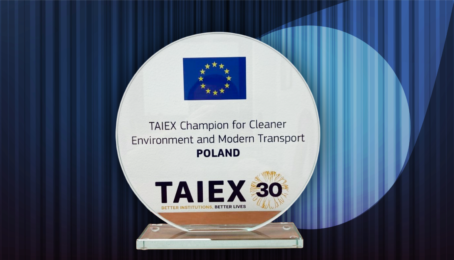
“TAIEX Champion” distinction – a joint success for CEUTP
During the “Institution Building Days 2026” conference held in Brussels on April 22-23, 2026, Poland was honored by the European Commission with the prestigious “TAIEX Champion” award.
More
 08 April 2026 | International cooperation
EU-Ukraine Solidarity Lanes Project Meeting in Lublin
The Centre of EU Transport Projects (CUPT), as consortium leader, brought together representatives of Polish and Ukrainian institutions at the Arche Hotel to review progress to date and set the direction for further work under the EU-Ukraine Solidarity Lanes initiative.
More
Contact us
Plac Europejski 2, 00-844 Warsaw
Monday – Friday,
hours: 8:15 am – 4:15 pm


