




Practical DNSH experience: from project assessment to monitoring implementation
Many institutions managing EU funds are still asking how to carry out DNSH monitoring, that is, how to check whether EU-funded projects comply with the Do No Significant Harm (DNSH) principle. This was the topic of the latest meeting of the DNSH peer2peer community, coordinated by the European Commission (DG REGIO). The meeting took place on 17 November on Microsoft Teams and brought together around 50 representatives of institutions from EU Member States responsible for implementing EU funds. Experts from the Centre for EU Transport Projects (CEUTP) were involved in organising the meeting.
The DNSH principle has been with us for several years, yet it is still a challenge and requires regular exchange of experience. There has been clear progress, though. All EU countries have already developed an approach to assessing whether projects meet the DNSH environmental objectives. They have also defined how to document and confirm that these requirements are met.
What DNSH means
The Do No Significant Harm (DNSH) principle means that investments financed from EU funds must not do significant harm to the environmental objectives of the European Union. Institutions assess this when selecting a project for funding and then monitor it during implementation.
Why DNSH monitoring is the biggest challenge today
The main challenge today is not assessing projects before funding is awarded, but monitoring whether they continue to comply with DNSH during implementation. Not all institutions have yet introduced a system or procedure for this verification. This is why sharing practical experience and learning from good practice is so valuable.
Experience from Slovakia
The first presentation was given by Lenka Satinova from the Ministry of Investment, Regional Development and Informatization of the Slovak Republic. She discussed the experience of recent years.
One interesting solution is a specialised environmental team within the Slovak Ministry of Environment. It assesses funding applications against the rules on environmental impact assessment (EIA). The team completes the review in just 20 days, because the scope of the check is limited and precisely defined. Experts check, among other things, whether the project has been correctly classified under EIA requirements, whether all required documents have been submitted, and whether the funding application declares compliance with the conditions arising from the EIA procedure.
The result is a formal document summarising the verification. It forms the basis for further assessment of the project.
Another interesting example was an Excel form presented by one of the Slovak intermediate bodies. It supports climate proofing analysis (assessing a project’s resilience to climate change) in line with the European Commission’s methodology. The solution seems useful for simple, small projects. However, it would be difficult to apply to more complex infrastructure projects, especially in transport, where a single project often includes several types of investment and activities.
It may be worth considering similar simplified tools for simpler projects, for example procurement of equipment, provided that the climate proofing requirement for such projects is not limited or simplified in the future. We hope that such simplifications will indeed come.
What is the approach in Finland?
The second presentation was given by Siina Lepola-Lång from the Ministry of Economic Affairs and Employment of Finland. She shared experience from renewable energy projects.
In Finland, DNSH compliance is assessed both when a project is selected for funding and later, during its implementation. One particularly interesting piece of information was that the authority assessing applications can require applicants to include additional measures to protect nature or biodiversity, even if they do not directly result from national law. In practice, these may be, for example, additional tree planting or other compensation measures that reduce the environmental impact of the investment. Beneficiaries are then obliged to carry them out.
Further discussion
In the second part of the meeting, participants discussed solutions used in other countries for the environmental assessment of projects and for DNSH monitoring. The topic attracted a lot of interest, so it was a pity that there was not enough time for more questions and further experiences. We will plan more time for discussion and exchange of practical experience at the next meeting.
Participants also asked about the new European Commission guidance on DNSH for the next EU programming period. They agreed that there is very little official information so far, and that the details of the new solutions remain unknown.
For experts from the Environmental Protection Department at CEUTP, the most valuable part of the meeting was the practical examples presented by participants. The discussion showed that many institutions in the Member States face very similar challenges. Despite different legal, institutional and geographical conditions, we are all talking about the same problems and understand each other very well.
The next meeting of the DNSH community is planned for next year.
More information about the peer2peer communities is available on the European Commission website:
go to the community pageInternational cooperation
 25 November 2026 | International cooperation
EIPA training in Athens with a CEUTP expert: strategic public procurement and avoiding errors
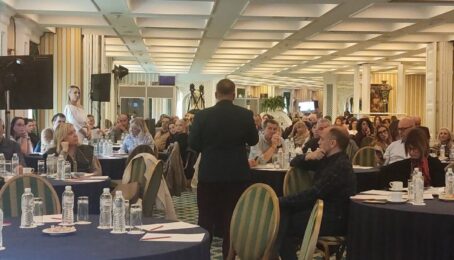
A CEUTP expert took part in an EIPA training session in Athens on strategic public procurement and avoiding errors in the procurement process. 141 participants registered.
More
 13 November 2026 | International cooperation
EIPA (European Institute of Public Administration) training session featuring a CEUTP expert
Read about the EIPA training session regarding the topic of strategic public procurement and avoiding errors in the procurement process, in which the CEUTP’s expert took part.
More
 28 October 2026 | International cooperation
DG REGIO Peer2Peer Public Procurement: another meeting within the framework of international cooperation
On October 22, another online meeting of the DG REGIO public procurement group took place, attended by an expert from the Centre for EU Transport Projects (CEUTP) and approximately 50 representatives from EU member state institutions involved in the management and control of EU-funded projects.
More
 16 October 2026 | International cooperation
How to Effectively Use EU Funds for Transportation?
On October 13 in Warsaw, representatives from nine EU candidate countries learned about Poland’s experience with infrastructure financing.
More
Contact us
Plac Europejski 2, 00-844 Warsaw
Monday – Friday,
hours: 8:15 am – 4:15 pm


